Word Problems: Learning to Choose the Operation Before Calculating
Why pupils add every number in the problem, and how to teach them to understand the situation before calculating.
Read the articleSwapped hands, the wrong hour, misread minutes, 12-hour or 24-hour time, durations: five classic mistakes and practical ideas for the classroom.
Telling time seems simple to adults, but it requires pupils to coordinate two hands, two scales and two ways of counting. There are many possible mistakes, and each calls for different work.
The pupil reads the short hand as minutes and the long hand as hours. Start with a clock that has only the hour hand: it is already enough to say “it’s about 3 o’clock.” Then add the long hand. A different color for each helps at first.
At 3:45, the short hand is almost on the 4. Many pupils read 4:45. Remind them of the rule: we take the number the hand has passed, not the one it is approaching. Slowly moving the long hand around a full turn shows how the short hand moves at the same time.
The long hand points to 9 and the pupil says “9 minutes.” What is missing is the link between the clock face and the minutes. Show a ring around the face with 00, 05, 10… up to 55. Count by 5s while following the hand, then gradually remove the ring.
Moving to 24-hour time means linking the clock to the course of the day. Start from real activities: what time does afternoon school start? How is that time written in a train station or on television?
10:50 plus 25 minutes is not 10:75. The pupil applies base-ten logic to a measure that changes units every 60. Split the duration on a timeline: first up to the full hour (10 minutes to reach 11:00), then the rest (15 minutes). That gets you to 11:15 with no written calculation.
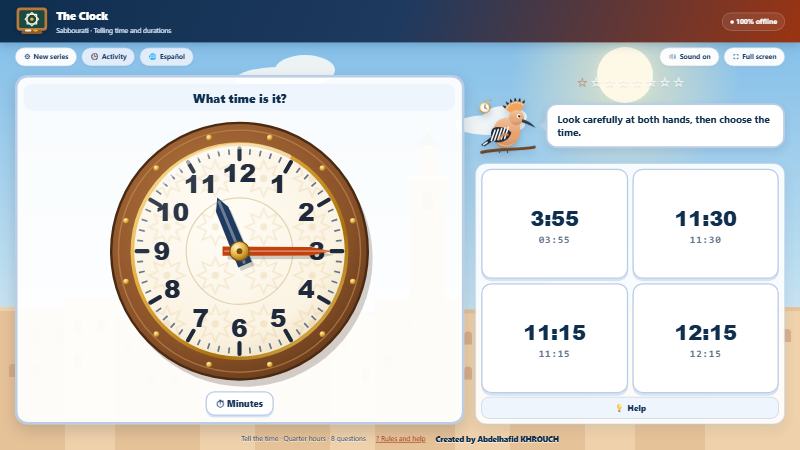 The ClockTell the time, set the hands and work out durations, in 12-hour or 24-hour format.See the game
At each stage, alternate between reading a clock and setting the hands for a given time. They are two different skills, and a pupil can succeed at one without mastering the other.
Why pupils add every number in the problem, and how to teach them to understand the situation before calculating.
Read the articleOne board, thirty pupils: how to organize teams and turns so that everyone is thinking during the game.
Read the articleNeatly upright lines hide the real concept. How to help pupils identify and check parallel and perpendicular lines.
Read the article