Word Problems: Learning to Choose the Operation Before Calculating
Why pupils add every number in the problem, and how to teach them to understand the situation before calculating.
Read the articleForgotten carrying, swapped digits, zeros in subtraction: how to read a pupil’s mistake and choose the right next step.
When a pupil makes a mistake in written calculation, it is tempting to give them ten more to do. But the wrong answer often holds valuable information: it shows exactly which step is causing trouble. You just have to tell the mistakes apart.
In 47 + 38, the pupil works out 7 + 8 = 15, writes 5, then adds 4 + 3 without carrying. The result is 75 instead of 85. Multiplication works the same way: for 36 × 4, the pupil writes 124 instead of 144, forgetting to add the carried 2 to 12.
This mistake rarely comes from not knowing the tables. It is a skipped step. So make carrying compulsory: the pupil says aloud “I carry…” at every column, even when the carry is 0.
In 64 − 28, some pupils work out 8 − 4 = 4 because they always take the smaller digit from the larger one. They get 44 instead of 36.
The problem comes from a misunderstood unwritten rule. Have them check with addition: 44 + 28 makes 72, not 64. The pupil sees that the answer doesn’t work without the teacher having to say so.
The subtraction 300 − 127 is a classic. There is nothing to take from the tens, so pupils don’t know what to do. Depending on your class’s method, work either on equal additions (adding 10 at the top and 1 at the bottom) or on regrouping step by step: one hundred becomes ten tens, then one ten becomes ten ones.
Keep to one method for the whole class. Switching between techniques increases confusion for pupils who are already struggling.
In 7 × 8 = 54, the procedure is correct but the fact is wrong. The work needed is different: short, regular times-table practice rather than going back over the written method.
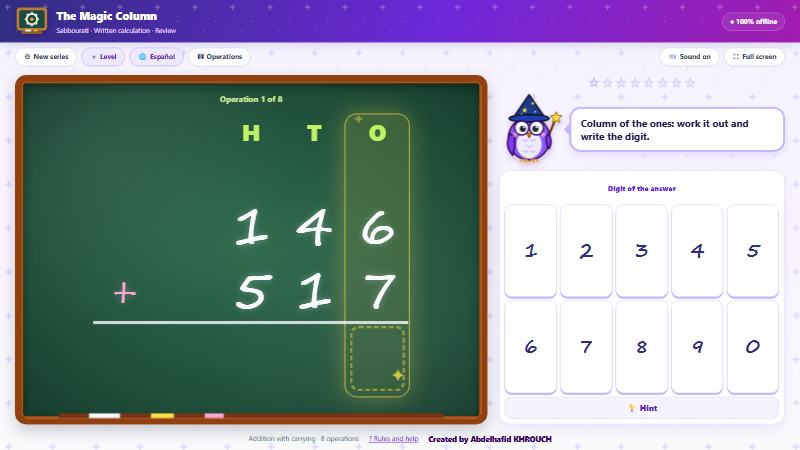 The Magic ColumnWritten addition, subtraction and multiplication, digit by digit, carrying included.See the game
This game asks about carrying after every digit and sorts mistakes at the end. It shows whether a pupil has really automated the step that was missing.
Why pupils add every number in the problem, and how to teach them to understand the situation before calculating.
Read the articleOne board, thirty pupils: how to organize teams and turns so that everyone is thinking during the game.
Read the articleSwapped hands, the wrong hour, misread minutes, 12-hour or 24-hour time, durations: five classic mistakes and practical ideas for the classroom.
Read the article