Word Problems: Learning to Choose the Operation Before Calculating
Why pupils add every number in the problem, and how to teach them to understand the situation before calculating.
Read the articleWriting 705 the way it sounds trips up many pupils. Where these mistakes come from and how to work on place value.
“Seven hundred five”: one pupil writes 75, another 7005, a third 7105. These answers look far apart, but they have the same origin. Pupils haven’t yet linked what they hear to the position of the digits in the number.
Dropping the zero. The pupil writes what they hear, seven then five, and gets 75. They think nothing needs to be written for an empty column.
Writing the number the way it sounds. The pupil writes 700, then 5 after it, and gets 7005. They place the parts of the number side by side instead of combining them. The same logic produces 40060 for four hundred sixty.
The first pupil doesn’t see the role of zero. The second hasn’t understood that hundreds and ones go into the same number. In both cases, base-ten materials and a place-value chart are useful.
With hundred flats, ten rods and cubes, build 705: seven flats, no rods, five cubes. Then put the materials in a three-column chart. The tens column stays empty, and that is exactly what the zero says.
Next, compare 75 and 705 side by side. Ask: “How many rods here? How many flats there?” The difference in quantity becomes obvious, when it was hard to see in the written number.
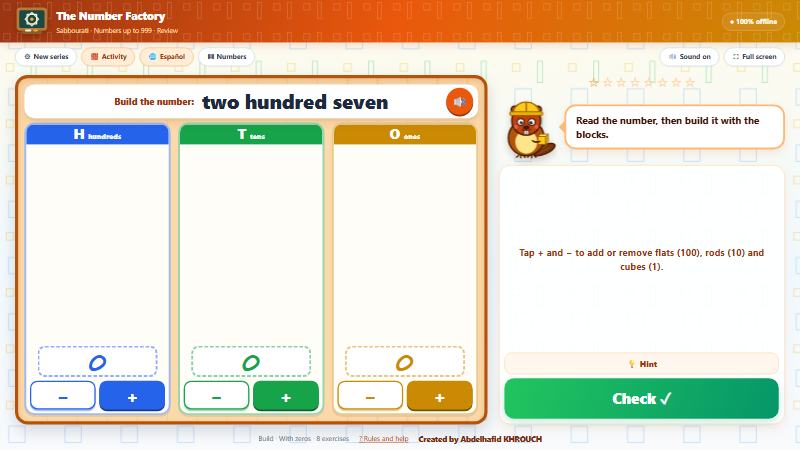 The Number FactoryBuild, write, break apart and place numbers with flats, rods and cubes.See the game
Ten cubes trade for a rod, and ten rods for a flat. Trading is the foundation of the whole system. Offer unorganized collections, for example 4 flats, 13 rods and 12 cubes, and ask for the number. Pupils have to trade: 13 rods become 1 flat and 3 rods, and 12 cubes become 1 rod and 2 cubes, which gives 542.
705 = 700 + 5, not 70 + 5. Offer correct and incorrect breakdowns to sort. Vary the forms too: 600 + 7, 7 hundreds and 5 ones, 70 tens and 5 ones. That last form prepares later work on large numbers and division.
A number line gives another picture of the number. Where does 705 go between 700 and 800? Very close to 700, which would be impossible if it were 75. This representation also helps with comparing and rounding.
A few numbers a day are enough, chosen to include traps: 408, 690, 805. Have pupils read each number after writing it, then build or draw it. Moving from spoken to written numbers, then to materials, strengthens the link between all three.
Why pupils add every number in the problem, and how to teach them to understand the situation before calculating.
Read the articleOne board, thirty pupils: how to organize teams and turns so that everyone is thinking during the game.
Read the articleSwapped hands, the wrong hour, misread minutes, 12-hour or 24-hour time, durations: five classic mistakes and practical ideas for the classroom.
Read the article